If you are a startup founder, there's a high chance you're losing sleep worrying about the success of your company.
Will you manage to attract investors? Will you be profitable? How high should you price your product?
What you need is to predict the future performance of your company. And the best to do so is with the help of a financial forecasting model. These models can tell you a great deal about your business, including how to gain more users, what to expect in terms of revenue, and more.
Find out the top 5 financial forecasting models and their benefits right here.
What Is Financial Forecasting?
Financial forecasting is the process of predicting the financial performance of any company, whether you're a B2B self-service or a B2C subscription-based startup.
If the main goal of SaaS metrics and pirate metrics is to assess the health and growth of your company, the main goal of financial forecasting is to give the organization, investors, and other stakeholders a sense of its financial future.
Forecasting is used to prepare budgets, loan applications, and other financial decisions. For instance, SaaS businesses particularly struggle to determine their SaaS pricing strategy as there's no cost associated with producing the software. Well, financial forecasting can help a SaaS business come up with the best price to sell its product, and so much more.
Why Financial Forecasting is Important
Some of the most notable benefits of financial forecasting are the following:
Reveals the financial viability of a business venture. You'll be able to see how your business might perform financially if you carry out certain strategies and plans.
Lets you evaluate the actual financial operation of your business and compare it with the forecast financial plan so that you can make the proper adjustments.
Helps you take control of your cash flow and move the business in the right direction.
Lays out a benchmark against which you can measure future performance.
Keeps your business out of trouble by identifying potential risks and cash shortfalls.
Estimates your future cash needs and whether additional borrowing or private equity is needed.
5 Financial Forecasting Models for Startups
A good financial forecasting model is the cornerstone of good governance. It helps an organization make good financial decisions in an efficient manner and makes the organization more transparent.
Financial forecasting models are specifically designed to address various areas of an organization's financial planning. These models help the company to clearly understand its financial performance and also provide vital information to investors.
The five best-known financial forecasting models for startups are:
There are many ways to forecast. One way is the top-down financial model.
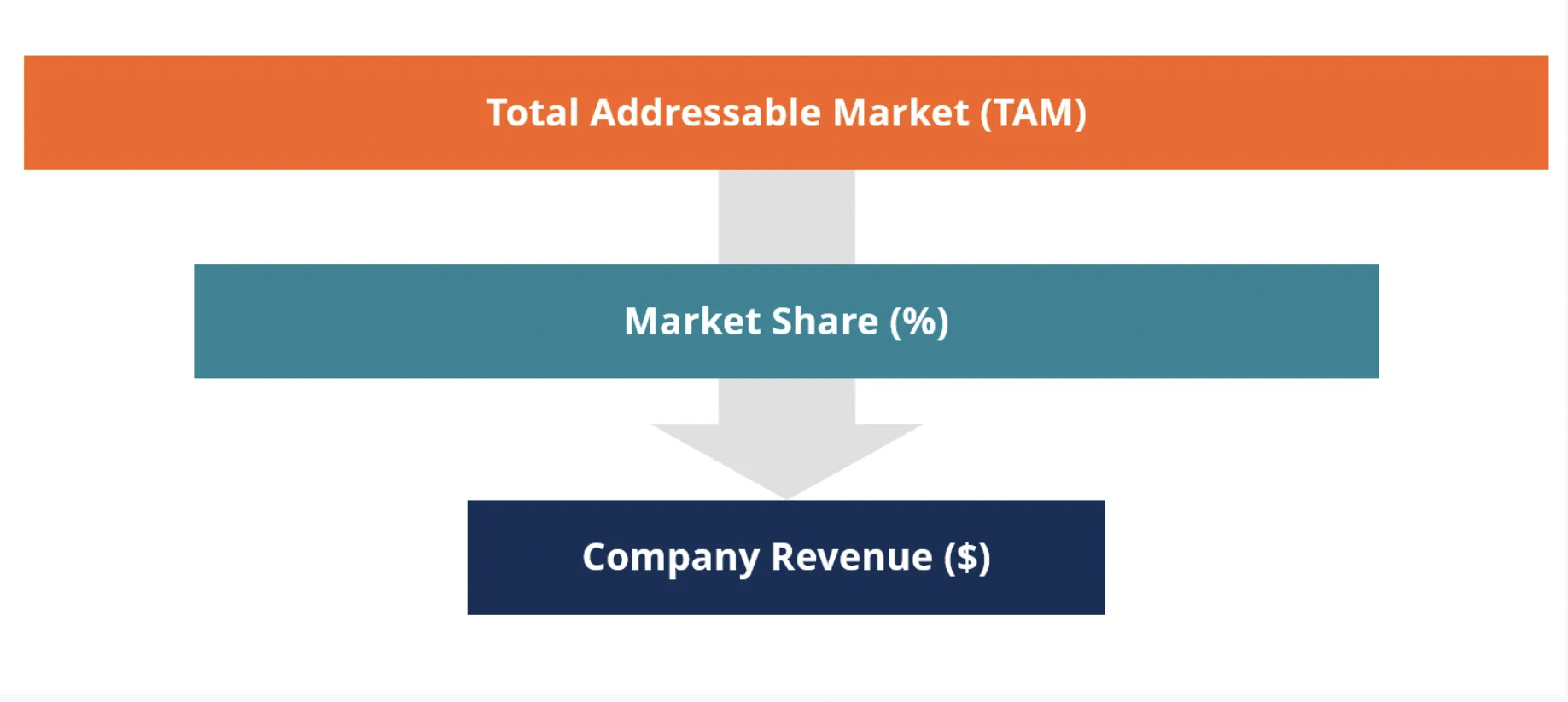
This type of financial model starts with looking at the big picture, usually the market as a whole. It looks at macroeconomic variables such as gross domestic product (GDP), employment, demographics, and the like. The idea is that you start with the overall picture and then work your way down to more specific variables.
Based on these variables, a business can determine how much of the market will buy its product or service.
As this model tends to give a more optimistic outlook, many businesses use it to attract investors. In addition, this model is the preferred option when it comes to strategizing and allocating resources.
Another reason why startups may opt for this model is that you don't need the most recent point of sale data to generate projections. Even better, the top-down financial model can tell a business whether the market is increasing or decreasing and thus evaluate its long-term profit potential.
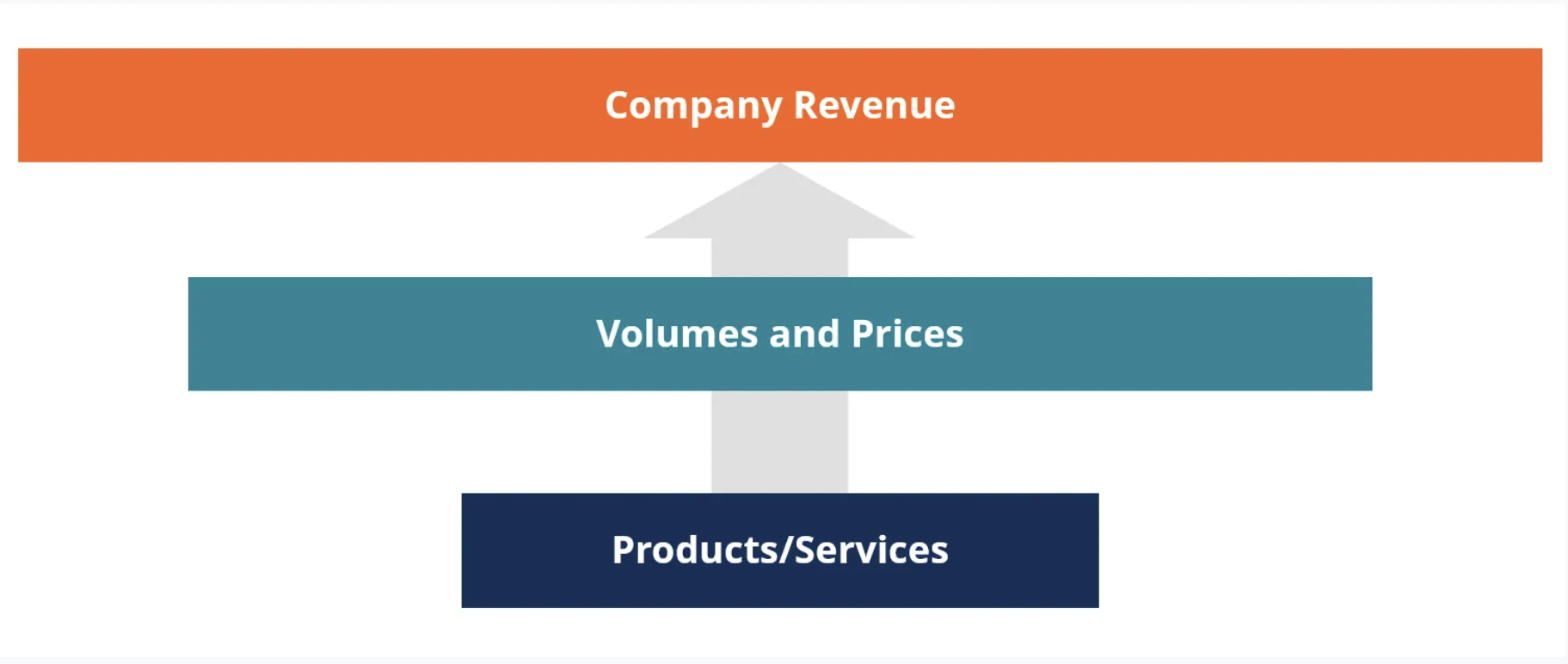
The bottom-up financial model is different from the top-down model in that it begins with more specific variables, such as the individual business itself, and expands out.
For example, it examines factors such as expenses, production capacity, and total available market. The business then uses this data to create a more accurate sales projection.
Compared to the top-down model that many startups prefer in order to attract investors, the bottom-up financial model offers a more realistic view as it uses actual sales data. Some businesses may prefer this model as it can enable them to arrive at better strategic decisions.
Another benefit of this approach is that it includes employees and managers in the budgeting process. Owners may assess costs by departments, such as hiring costs, marketing fees, and distribution expenses. Business owners can then inform department managers on the best ways to manage their budgets, and managers will be more inclined to adhere to the budget as they were involved in the process themselves.
The Delphi forecasting method is based on the idea that a group of experts can forecast better than any individual expert. It's a structured technique that uses a panel of experts, a structured questionnaire, and a process of group discussion to forecast future events.
The method creates a collective forecast by repeatedly asking the group of experts to provide their anonymous forecasts, estimates, opinions, judgments, or conclusions.
The Delphi forecasting method is one of the most widely-used forecasting techniques globally that can be applied to any number of different scenarios, from planning and forecasting to public opinion polling and project management.
The technique was developed in the 1950’s by Olaf Hemler and Normal Dalkey of the Rand Corporation. The name derives from the Oracle of Delphi, the high priestess of the Temple of Apollo that was best-known for prophecies.
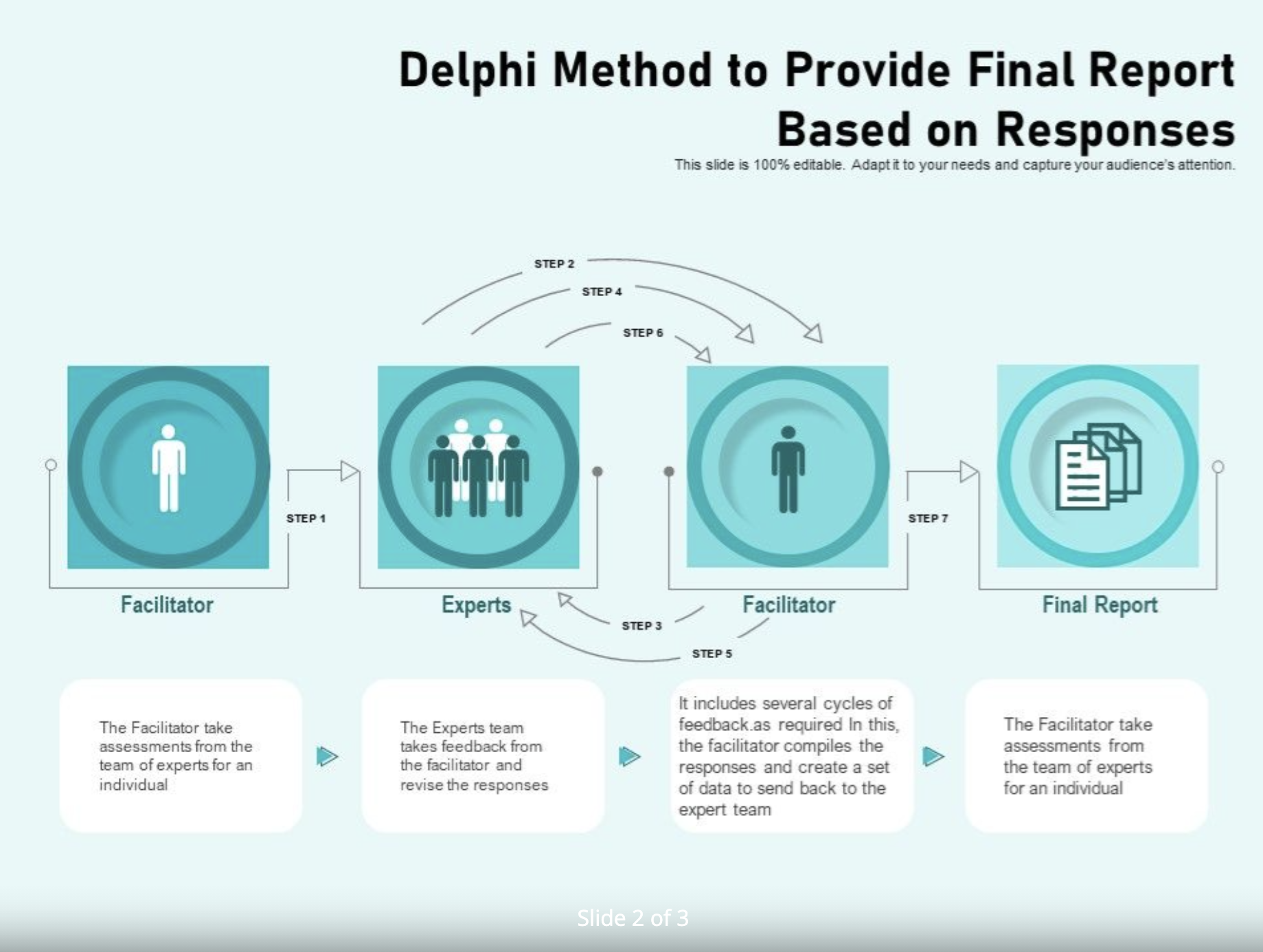
In short, this is how Delphi forecasting works:
The group facilitator selects a group of experts relevant to the topic that is being examined.
Each expert receives a questionnaire. They state their opinion or experience on the topic.
The facilitator receives the experts' questionnaires and groups the comments.
The aggregated comments are sent to each expert. The experts can change their answers based on how they interpret the "group response" provided to them.
All questionnaires are returned to the facilitator. The facilitator decides if another round is necessary.
There can be as many rounds as needed until the participants reach a consensus.
The Delphi method comes with both advantages and disadvantages. One major benefit of this method is that it seeks opinions from a diverse set of experts. On the plus side, it doesn't have to be a live discussion where each member participates physically.
On the downside, live discussions tend to involve more interactions than discussions that don't happen in person. For instance, live discussions can help participants reach consensus faster as ideas are more easily discussed, broken down, and reassessed. Forecasting using the Delphi forecasting method can take weeks, if not months.
Build your customer referral program without the dev time
Sign up for a free trial of GrowSurf to lower your customer acquisition costs, increase customer loyalty, and save gobs of time.
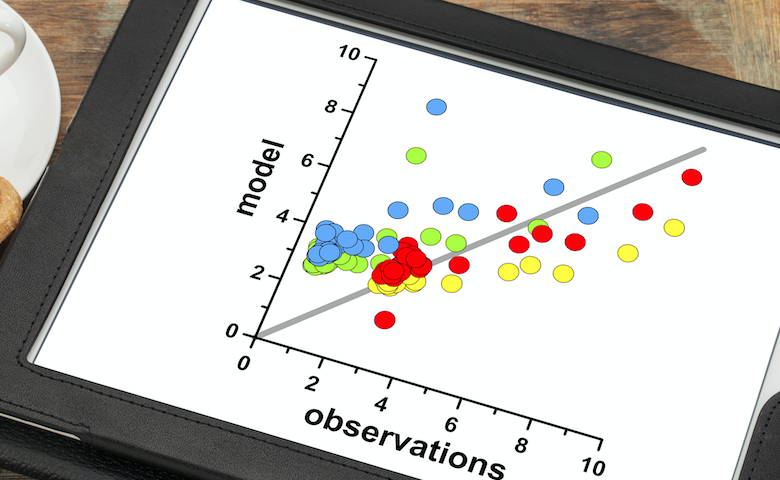
Correlation-based forecasting models are another popular financial forecasting technique. These models pin down correlating variables and examine their relationship. For instance, by examining how prices and costs or supply and demand affect each other, decision-makers can more easily predict financial outcomes.
Statistical Forecasting Models
Quantitative forecasting models are just one of the many tools in your toolkit. And while they’re not the only way to accurately forecast demand, they are definitely one of the best.
By using these methods, businesses can create relationships between the findings of other disciplines. The end goal is to predict how your business operation compares to other similar businesses. Most commonly, these models use the Gaussian analysis that can be helpful in modeling and mitigating risks and forecast the probabilities of future outcomes.
Financial Forecasting for Startups
As a startup, financial forecasting is one of the most important factors to consider.
Unfortunately, due to the lack of sufficient realistic data, many entrepreneurs put off making financial projections.
However, the good news is that by choosing the best financial forecasting model and consulting with the right people, you'll gather just enough data to make realistic financial projections.
Here are three steps to take to get started with financial forecasting for your startup.
Decide on a Financial Forecasting Model
The two most commonly used models, as discussed above, are the bottom-up and top-down models. Early-stage startups may realize they don't have enough data points to create projections using the bottom-up financial model. One way of using this approach is to use data from your competitors, but keep in mind that every business operates differently.
A better approach for early-stage businesses would be the top-down model.
Ask for Your Team's Input
Another great way to gather enough data and build realistic financial projections is to consult with your team members.
The best team members to ask for input are:
The Business Owner: They possess vital information, such as an in-depth understanding of the business's needs, the target market, and opportunities.
The CFO: They can analyze your financial data, make reports, and come up with recommendations on how you can make your business more profitable. If you haven't hired a CFO, consider working with a contractor.
The Sales Leader: They can offer insight into the sales strategy and potential of your business.
Generate Projections for Critical Financial Statements
When making financial projections, focus on these three financial statements that are critical for your business:
Income statement, also known as profit and loss statement. It includes four items: revenue, expenses, gains, and losses.
Cash flow statement that examines the movement of cash in and out of your business in the form of expenses and income.
Balance sheet that shows your business’s finances at a particular point in time. It includes assets, liabilities, and owners’ equity.
Key Takeaways
Here's a fact:
Investors and lending institutions have seen many business owners who are overly optimistic about their business's financial performance.
The trick is to strike a balance between being optimistic and realistic. Choose the financial forecasting model that's best for your business and create realistic projections.
Making your projections reliable, that's the best way to convince investors that your business is legitimate and has the potential to grow.
To sum up:
Financial forecasting is the process of predicting the financial performance of a company.
The main goal of financial forecasting is to give the organization, investors, and other stakeholders a sense of its financial future.
Financial forecasting models are great tools that assist companies in understanding their financial performance. They also provide vital information to investors.
The five best-known financial forecasting models for startups are the top-down model, button-up model, Delphi method, correlation-based models, and statistical forecasting models.
Many startups prefer the top-down model as it gives a more optimistic outlook and can be helpful in attracting investors.
The Delphi method is another widely used technique that's based on the idea that a group of experts can forecast better than any individual expert.
Another great way to gather enough data and build realistic financial projections is to consult with your team members.
Three financial statements are critical for your business when making financial projections, including the income statement, cash flow statement, and balance sheet.
Build your customer referral program without the dev time
Sign up for a free trial of GrowSurf to lower your customer acquisition costs, increase customer loyalty, and save gobs of time.
GrowSurf is modern referral program software that helps product and marketing teams launch an in-product customer referral program in days, not weeks. Start your free trial today.
GrowSurf is modern referral program software that helps product and marketing teams launch in-product referral and affiliate programs in days, not weeks.
Learn what made the Tesla referral program effective, bringing 40x ROI with a $0 advertising budget. Tesla's choice of referral rewards was key in their success
Customer churn analysis can bring life-changing results to your business and can be done in 3 easy steps. Learn how to calculate and reduce churn today.
SaaS referral programs are one of the most cost-efficient ways for startups to gain new signups and paying customers. Here's 5 reasons why and examples to study
SaaS pricing can be one of the most challenging parts of operating a software company. Here is a breakdown of how to make a successful SaaS pricing strategy.
Websites may store or retrieve information on your browser, mostly in the form of cookies. This information is used to personalize your experience and is not usually linked to your identity. You can choose not to allow certain types of cookies, but it may affect your website experience. Learn more and change settings by clicking on the different categories.
Strictly necessary cookies enable website functionality and cannot be turned off. They are typically set in response to actions you take, like setting privacy preferences, logging in, or filling in forms. You can block or receive alerts about these cookies, but some website features may not work. These cookies do not store personal information.
Performance cookies track site visits and traffic sources to measure and improve site performance. They provide information on popular pages and visitor behavior. The information collected is anonymous. If you do not allow these cookies, we will not know when you have visited the site and cannot monitor its performance.
Targeting cookies are cookies that our advertising partners may set on our site. They use them to create a profile of your interests and show relevant ads on other sites. They do not store personal information, but use your browser and internet device's unique ID. Without these cookies, you will see less targeted ads.
Functional cookies improve your website experience through enhanced functionality and personalization. They are set by us or third-party providers. Without them, some or all of these services may not work properly.
1. Share your unique link with friends or colleagues that are looking for a referral marketing software solution.
2. If your friend becomes a GrowSurf customer (31 days after their first payment), we'll send you a $100 gift card and your friend will get a $100 discount on their first invoice.
3. Keep sharing GrowSurf to stack your referral rewards (there are no limits!).
Referral Program FAQ
I know someone whose company could use GrowSurf. How can I make a referral? To start the referral process, please sign up (or log in) to our referral program here. Once you’ve signed up, you can share your unique referral link via email, social networks, and direct email invite. Please note, in order to take part in our referral program, terms and conditions apply. You may view the terms of service of our referral program here.
What is a successful referral? In order for a referral to count, the person you’ve referred must be brand new to GrowSurf when they sign up and have passed our minimum qualified lead requirements. They must not have been contacted by our team or been a customer or trial user of GrowSurf prior to signup.
How do I know how many of my referrals have signed up? Once you’ve signed up for our referral program, you will be able to see how many of your referrals have signed up by logging into our referral portal here.
If one of my referrals books a demo call, when and how do I get my reward? All referrals must be qualified prospects based on our minimum requirements. We manually approve all rewards after a demo call is completed. Once your reward is approved, you will receive an email from us notifying you with more details.
My referral forgot to use my unique referral link to sign up. Is there a way I can still receive credit? Please contact our team at support@growsurf.com to assist you.
Terms of Service
All referrals are manually approved by our team. Self-referrals are not allowed. Abuse or gaming will result in having your account banned.
Referral program is limited to GrowSurf customers (including members of paid GrowSurf team accounts)
This offer cannot be combined with any other affiliate or promotional offer


 Salesforce
 Stripe
 HubSpot
 Chargebee
 Recurly
 PayPal
 Tango Card
 Webhooks
 Zapier